Signed in as:
filler@godaddy.com
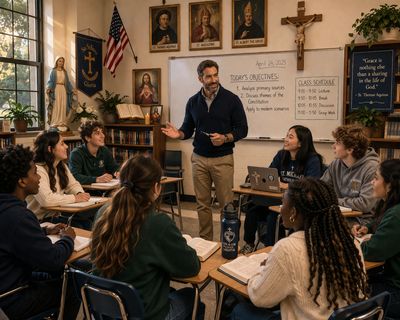
Students will learn the fundamentals behind technologies such as computers, 3D printing, drones, and related emerging tools. Through guided demonstrations and experimentation, they will gain practical insight into how these systems operate and how technological design reflects logical structure and creative problem-solving. The course explores the intersection of faith, reason, and technological innovation through the lens of the Catholic intellectual tradition; inviteing students to examine how modern technologies function while reflecting on their moral and philosophical implications.
This class introduces students to the art of reasoned debate and persuasive communication through the lens of the Catholic intellectual tradition, integrating faith and reason in the pursuit of truth.
Students will explore the foundations of rhetoric beginning with Aristotle’s Rhetoric, learning how logic, credibility, and emotional appeal work together in effective argumentation. They will be introduced to structured debate formats, including styles inspired by UK and Oxford models, while also learning the essential principles of civil discourse. Emphasis is placed on charity, clarity, and intellectual humility — equipping students to disagree thoughtfully and respectfully.
Throughout the year, students will participate in both individual and team debates, developing skills in research, argument construction, rebuttal, and confident public speaking. They will also practice audience engagement techniques, learning how to present ideas clearly, persuasively, and with poise.
Building upon foundational skills, students will engage more thoroughly with classical rhetorical theory, including Aristotle’s Rhetoric, principles of logical argumentation, and the structure of formal debate. Greater emphasis is placed on analytical precision, evidence-based reasoning, and the philosophical underpinnings of persuasive discourse.
Students will participate in structured debates modeled after UK and Oxford formats, with heightened expectations for preparation, clarity, and strategic thinking. Particular focus is given to rebuttal: students will learn to listen carefully, identify weaknesses in opposing arguments, and respond thoughtfully and confidently in real time. The ability to “think on one’s feet” is cultivated through timed responses, cross-examination, and impromptu speaking exercises.
This course is designed to introduce the student to the concept of apologetics. This is not an apology in the common use to mean being sorrowful for one’s offense and seeking forgiveness. Rather, this course follows the concept of apology as defense. The defense of a principle, argument, logical statement. As the above quote states, the Christian is to be always ready to account for the hope that he holds, and to articulate that hope in a spirit of charity (truth and willing the good of the other).
This course examines the reasonableness of the Catholic faith, and how one can come to know truth through reason. This is especially important when engaging with non-Christians (other faiths) and non-believers (pagans, agnostics, and atheists). This study builds on the foundations from last year (Bible and Catechism), which focused on how to engage with those who share a biblical foundation. By learning to use reason, science, and natural law, students will build a foundation to engage those who do not yet accept scripture. A much different dialog!
This course is designed to introduce the student to the writings of the Early Church Fathers. This is a survey course of the Church Fathers, with a focus on the those up to the time of (and including) St. Augustine. We will read and study how their own words defend the truth of the Catholic Church and refute heresy. We will also explore how their writings can help us grow closer to Christ and his Church in our own pray life and lived example of the gospels.